
Connection 1 of 4
One pixel currently has three answers
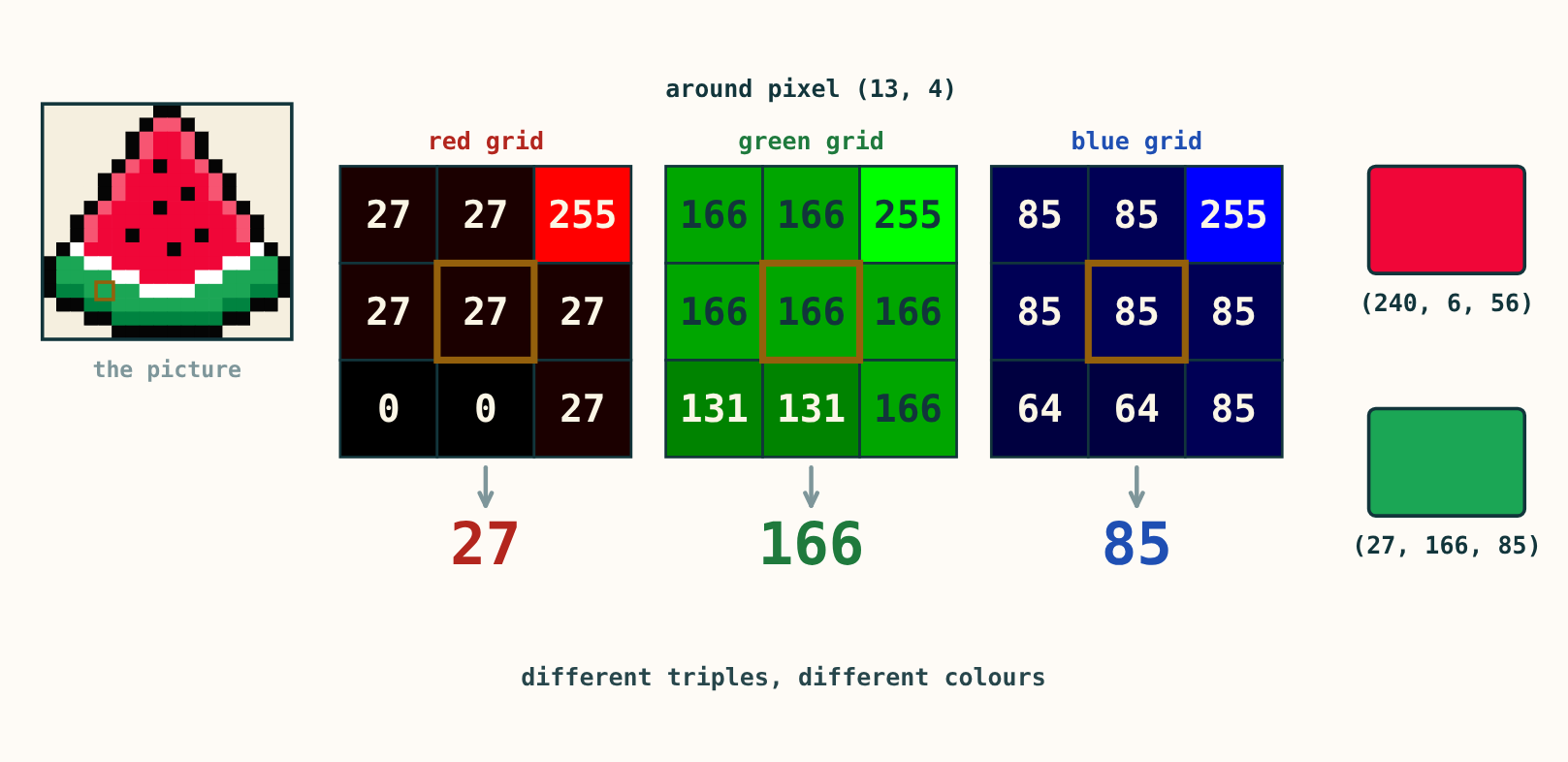
Pixel (13, 4) of the watermelon: its red, green and blue grid values 27, 166 and 85 are exactly the colour shown, here beside the red flesh pixel (240, 6, 56).
Each pixel of the watermelon stores a red, a green and a blue value. The red flesh pixel at row 10, column 4 is (240, 6, 56): a lot of red, almost no green, a little blue. A grayscale pixel needs one brightness-like answer, so we need a rule for combining three numbers into one.
Connection 2 of 4
The contributions are not equally weighted
The lesson uses a common weighted grayscale approximation: green counts most, then red, then blue. The weights are fixed, not learned, and this is not the only rule or an exact physical luminance.
The sum is rounded to the nearest whole number.
gray = round(0.299R + 0.587G + 0.114B)Read it as: Multiply each channel by its weight, add the three terms, then round.
Connection 3 of 4
Follow one pixel through the calculation
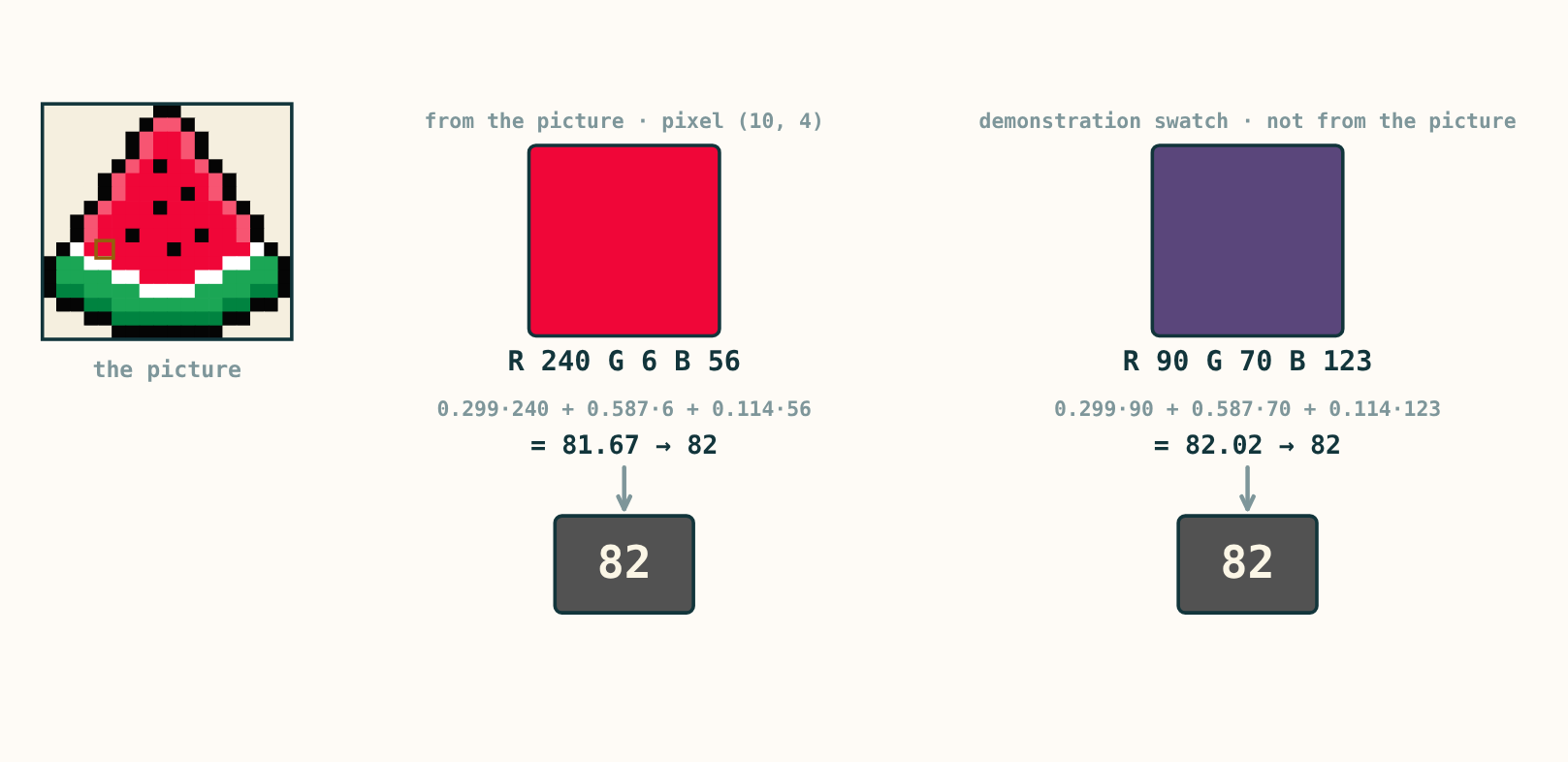
Two different colours, the red pixel (240, 6, 56) and a labelled demonstration swatch (90, 70, 123), both round to the gray value 82.
For the red flesh pixel (240, 6, 56): 0.299 × 240 = 71.76, 0.587 × 6 = 3.522 and 0.114 × 56 = 6.384. They add up to 81.666, which rounds to 82.
A pixel with equal channels, such as (100, 100, 100), keeps its value because the weights add to one.
71.76 + 3.522 + 6.384 = 81.666 ≈ 82Read it as: The three weighted terms sum to 81.666, which rounds to 82.
Connection 4 of 4
Why we cannot reconstruct the original colour
A demonstration swatch (90, 70, 123), which is not from the picture, gives 26.91 + 41.09 + 14.022 = 82.022, which also rounds to 82. Two clearly different colours, one gray value.
So the gray value alone cannot say which colour produced it. Repeating it into three channels gives a neutral image, not the original colours; the spatial layout stays, the colour distinctions are lost.
Connect it back to the picture
Grayscale is a weighted combination that keeps one brightness per location and loses colour information. It is a trade-off, not better or worse than colour.
Full notation and technical reference
The expressions below collect the operations discussed above. You can return here when you want the compact notation.
gray = round(0.299R + 0.587G + 0.114B)- R, G and B are channel values between 0 and 255; the weights are fixed, not learned.
- This is a common weighted approximation, not the only rule and not exact physical luminance.
Numerical reference
The watermelon's red flesh pixel (240, 6, 56) gives 71.76 + 3.522 + 6.384 = 81.666, which rounds to 82. A demonstration swatch (90, 70, 123) also gives 82.
Where this explanation stops
Three values per pixel become one, so different colours can share a gray value and the original colours cannot be recovered. Locations and brightness remain.