
Connection 1 of 4
Read the numbers as responses
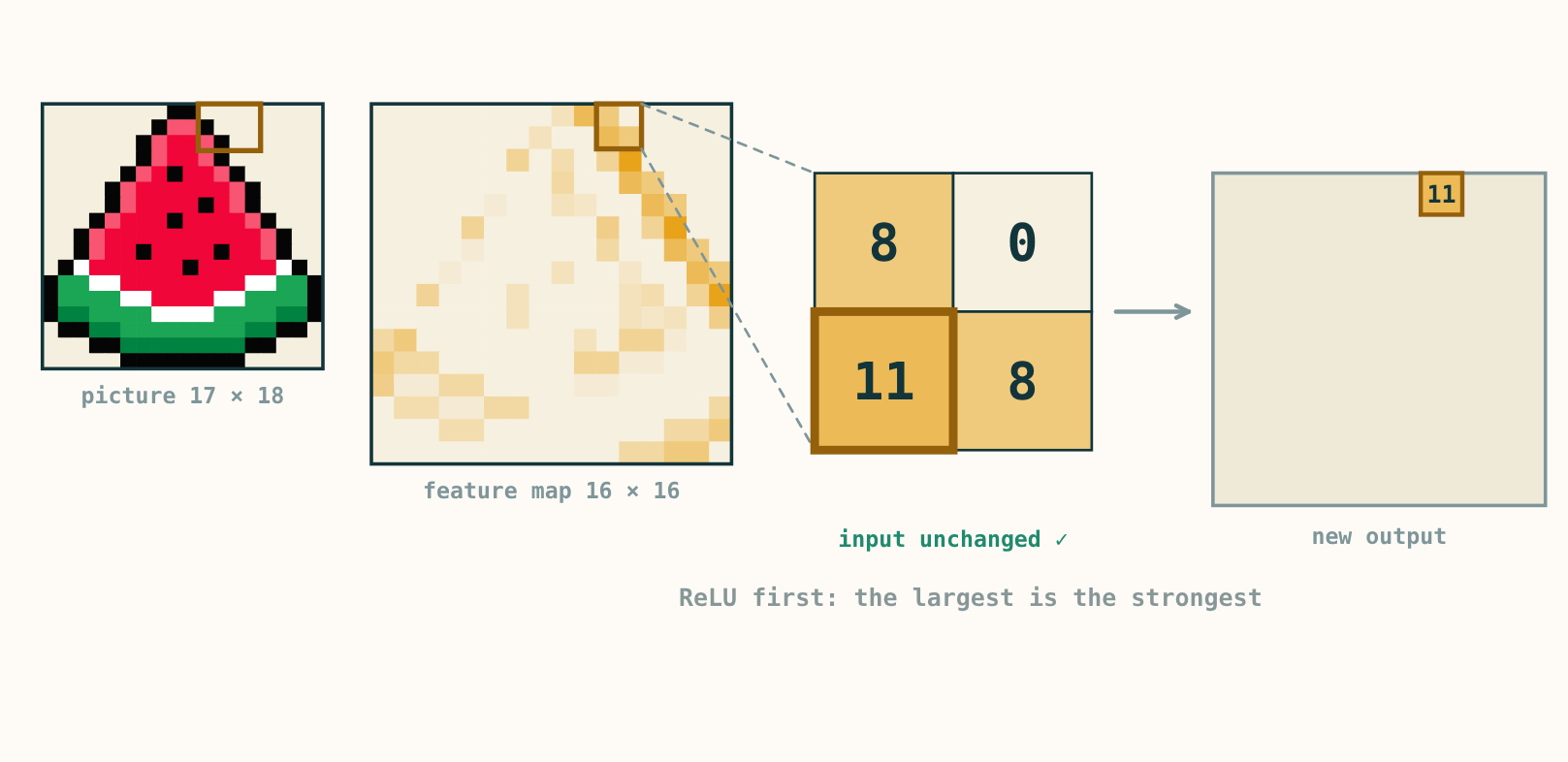
The largest of four responses, 11, is copied into one cell of a smaller output map; the four source cells stay as they were.
These are responses from a fixed filter followed by ReLU, not pixel brightness. A larger value means a stronger brightening step at that place. In the block 6, 16, 0, 11 the strongest evidence is 16.
max(6, 16, 0, 11) = 16Read it as: Max asks “which response is strongest here?” rather than “what is the average?”
Connection 2 of 4
Why the smaller map has one quarter as many cells
A 2 × 2 window covers four locations. With stride 2 the next window begins two cells over, so these windows do not overlap, and with no padding every window fits. Sixteen columns become eight, and the same happens to rows. Other window and stride settings can overlap.
⌊(16 − 2) / 2⌋ + 1 = 8, so 16 × 16 → 8 × 8Read it as: Both dimensions halve; the total number of locations becomes one quarter.
Connection 3 of 4
Move the evidence and watch what survives
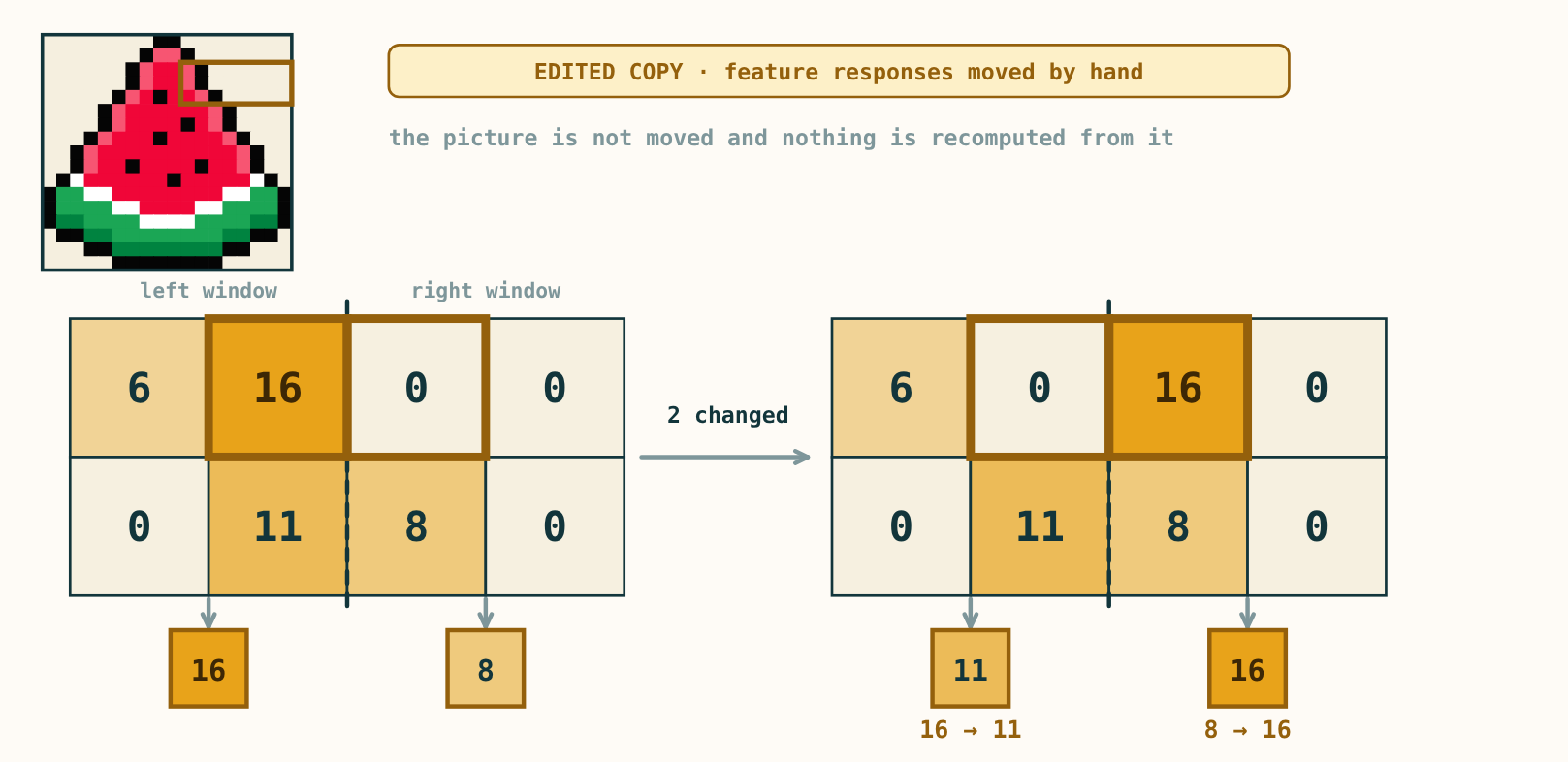
A controlled edit moves the 16 one cell across the window boundary: the two pooled outputs change from 16 and 8 to 11 and 16.
Move the 16 to another corner of its own block, as a controlled edit of a copy, and the maximum is still 16. Move it one cell to the right, across the block boundary, and the left output falls from 16 to 11 while the right one rises from 8 to 16.
This is a limited tolerance to movement within a pooling region, not immunity to every shift.
Connection 4 of 4
Name the information we discarded
Knowing that the maximum was 16 does not tell us which of the four cells held it, or that the other three were 6, 0 and 11. Several different blocks can produce the same output.
The smaller representation keeps a kind of evidence, while giving up some detail about its arrangement. It does not make the network's predictions better by itself.
Connect it back to the picture
Max pooling trades precise local arrangement for a compact statement that strong evidence occurred somewhere in the block.
Full notation and technical reference
The expressions below collect the operations discussed above. You can return here when you want the compact notation.
pooled(r,c) = max { map(2r+i, 2c+j) : i,j ∈ {0,1} }- The lesson builds a 16 × 16 map from the watermelon with a fixed 2 × 3 filter and a ReLU; nothing is trained.
- It then uses a 2 × 2 window, stride 2 and no padding: 16 × 16 becomes 8 × 8, since ⌊(16 − 2) / 2⌋ + 1 = 8.
Numerical reference
For the block [6, 16; 0, 11], the pooled value is 16. Moving that maximum to another corner of the same block leaves this output unchanged.
Where this explanation stops
Pooling discards the other values and their position inside the block. Moving the 16 one cell across the block boundary changes two outputs (16 to 11 and 8 to 16); pooling does not guarantee invariance to every movement.