
Connection 1 of 5
Accept at or above the line
A box is accepted when its score is at least the threshold. At 0.60 the five boxes A to E pass; E sits exactly on the line at 0.60, and the inclusive rule keeps it. F (0.42) and G (0.34) are set aside and are never judged.
accept ⇔ score ≥ tRead it as: The same scores give a different set of yeses for every threshold; accepted does not yet mean correct.
Connection 2 of 5
Match one to one, with enough overlap
Accepted boxes are checked from the highest score down. Each takes the unused reference box with the largest intersection over union, if that overlap is at least 0.50. Box A covers the large melon with 2754 / 3190 ≈ 0.86; box D reaches only 672 / 1882 ≈ 0.36 on the small melon, so it does not match.
IoU = area(box ∩ reference) / area(box ∪ reference) ≥ 0.50Read it as: The 0.50 overlap rule is a second threshold, separate from the confidence threshold.
Connection 3 of 5
Three kinds of outcome
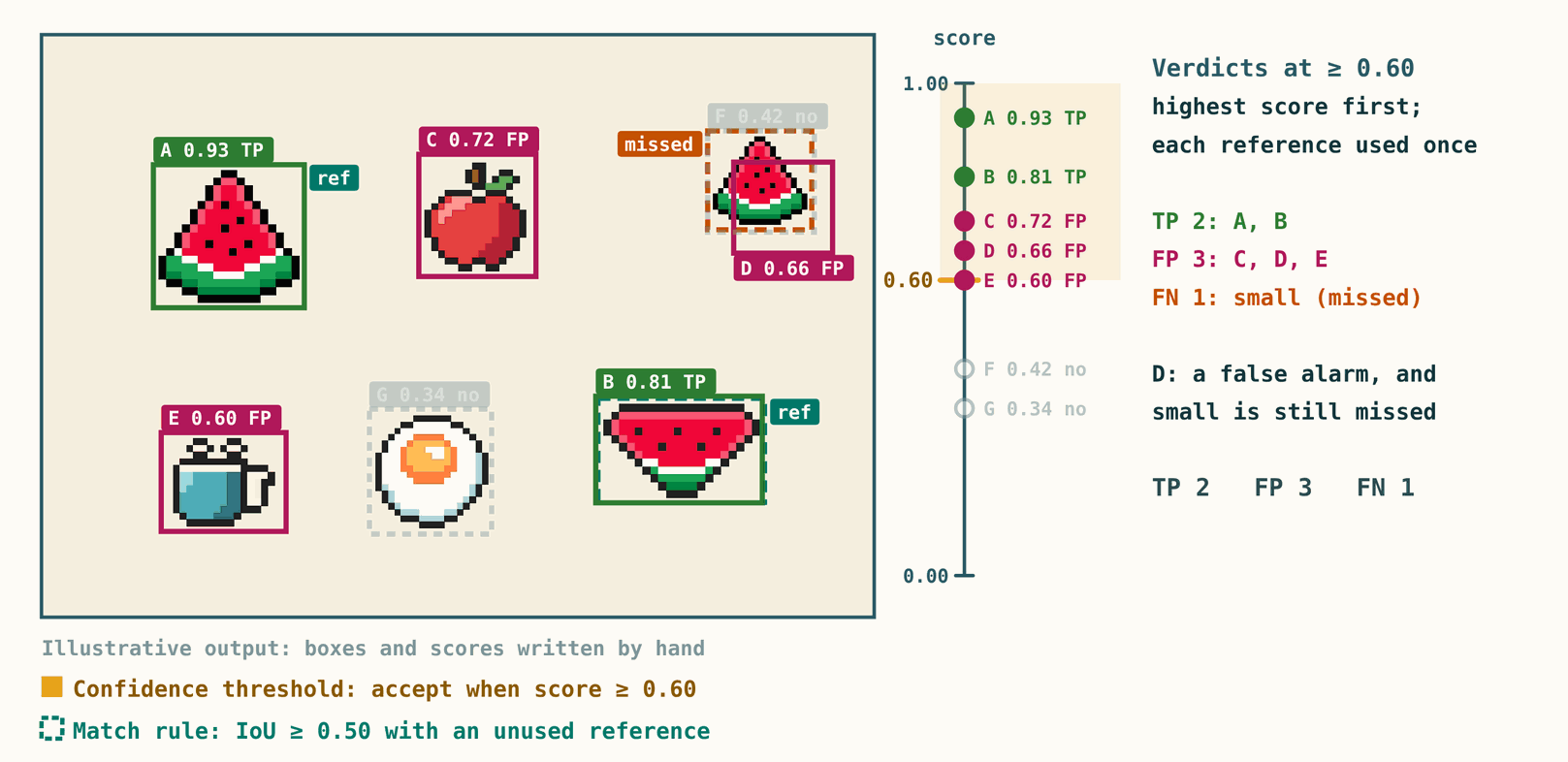
At a threshold of 0.60, A and B match reference boxes (TP), C, D and E match nothing (FP), and the small watermelon is missed (FN).
A matched accepted box is a true positive. An accepted box that matches nothing is a false positive, a false alarm. A reference box that no accepted box matched is a false negative, a miss. At 0.60 the picture gives TP 2 (A, B), FP 3 (C, D, E) and FN 1 (the small melon); box D alone causes both a false alarm and a miss.
TP + FP = accepted = 5, TP + FN = references = 3Read it as: Every accepted box is counted once, and every reference box is counted once.
Connection 4 of 5
Two ratios from the counts
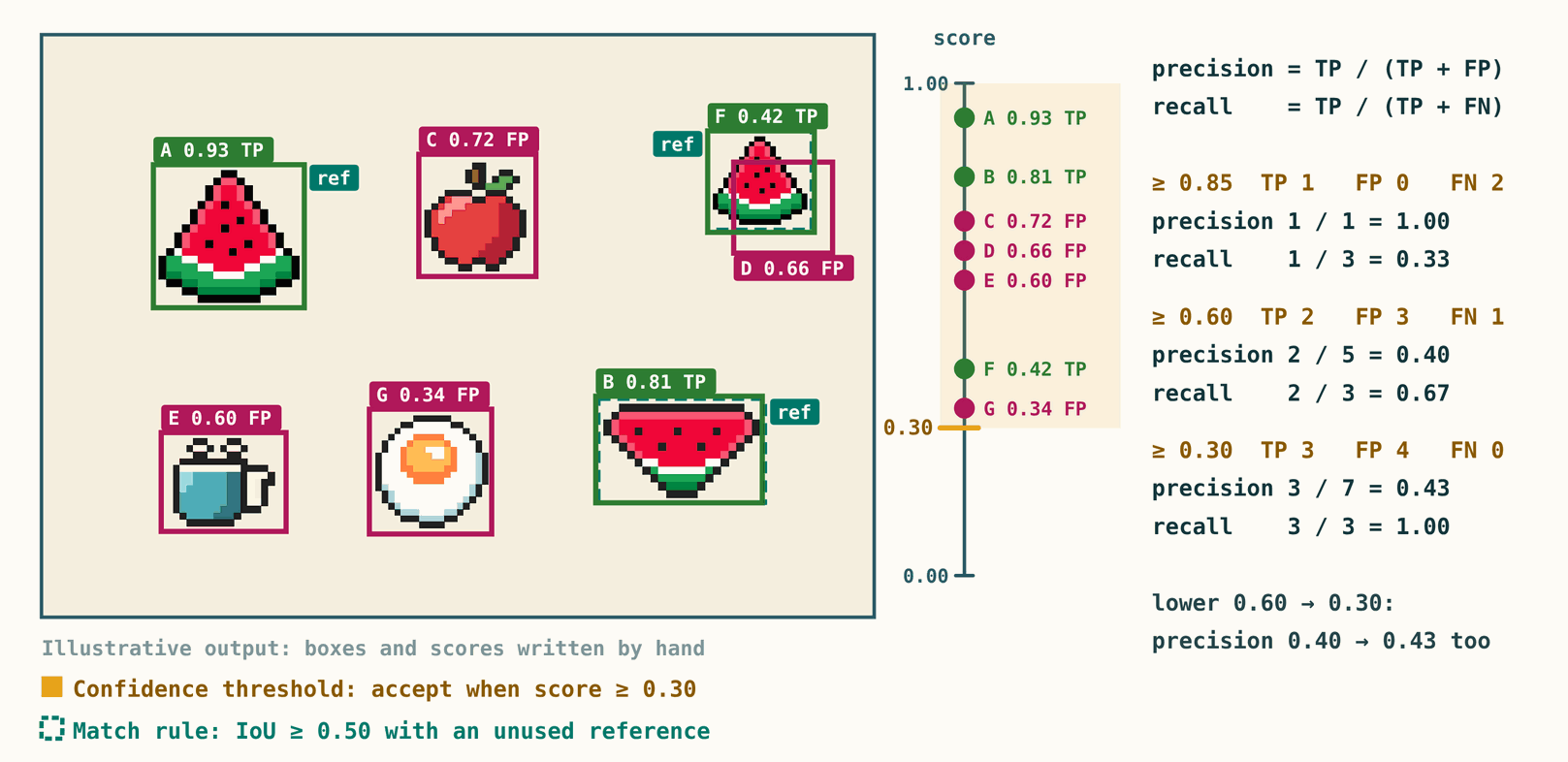
Precision and recall at 0.85, 0.60 and 0.30, computed from the counts; lowering the threshold from 0.60 to 0.30 raises precision from 0.40 to 0.43.
Precision divides the correct yeses by all the yeses; recall divides the watermelons found by all the watermelons. At 0.85 they are 1/1 and 1/3, at 0.60 they are 2/5 and 2/3, and at 0.30 they are 3/7 and 3/3.
Raising the threshold to 0.85 removed three false alarms but also the correct box B. Lowering it from 0.60 to 0.30 raised precision from 0.40 to about 0.43, because the newly accepted box F was correct: precision does not simply follow the threshold.
precision = TP / (TP + FP), recall = TP / (TP + FN)Read it as: Precision asks how many yeses were right; recall asks how many objects were found.
Connection 5 of 5
When a denominator is empty
At 0.95 nothing is accepted, so precision would be 0 / 0. That is undefined, and the lesson shows a dash instead of a misleading 0. Recall stays defined: 0 / 3 = 0, because all three watermelons are missed.
precision = 0 / 0 → undefined, recall = 0 / 3 = 0Read it as: No yes at all leaves nothing to be right or wrong about.
Connect it back to the picture
A threshold chooses between false alarms and misses. Counting against a separate reference shows which, and precision and recall summarise that choice for this one labelled picture, not for a detector in general.
Full notation and technical reference
The expressions below collect the operations discussed above. You can return here when you want the compact notation.
accept ⇔ score ≥ t
match ⇔ IoU(box, unused reference) ≥ 0.50, highest score first
precision = TP / (TP + FP), recall = TP / (TP + FN)- t is the confidence threshold: 0.85, 0.60, 0.30 and 0.95 in the lesson. The seven boxes and their scores are illustrative, written by hand; no model produced them.
- IoU is intersection over union. Its 0.50 limit is a second, separate threshold that decides matching, not acceptance.
- Each reference box can be matched once. A ratio with an empty denominator is undefined, not zero.
Numerical reference
At t = 0.60 the boxes A to E are accepted (E scores exactly 0.60). A and B match the large melon and the wide slice (IoU 0.86 and 0.82); C, D and E match nothing (D overlaps the small melon by only 0.36). TP = 2, FP = 3, FN = 1, so precision = 2/5 = 0.40 and recall = 2/3 ≈ 0.67.
Where this explanation stops
These counts describe one labelled picture and one illustrative set of boxes, not a detector's general performance. Precision does not have to rise when the threshold rises: lowering it from 0.60 to 0.30 raised precision to 3/7 ≈ 0.43. Average precision, precision-recall curves and duplicate suppression are outside this lesson.